Movement Skills Are Not Automatically Learned
Most parents think children naturally develop coordination as they grow.
But modern research shows something different:
👉 movement skills must be practiced.
And the years between ages 6 and 8 may be one of the most important stages for building those abilities.
In today’s world, where children spend increasing amounts of time:
- on screens
- indoors
- sitting
- consuming passive entertainment
many children are missing critical movement experiences that help develop confidence, balance and coordination.
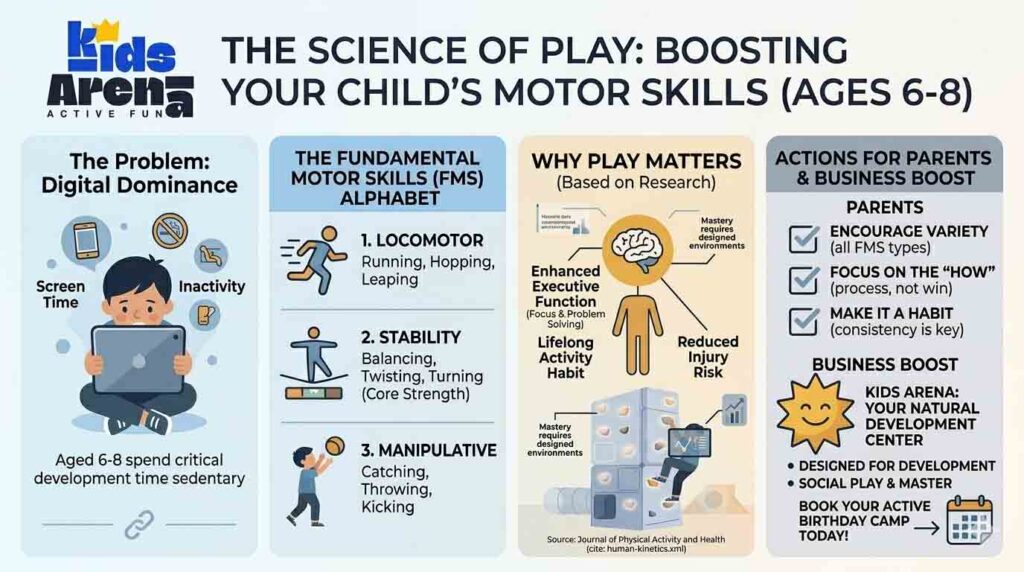
Research on Fundamental Motor Skills (FMS) suggests that children need active environments that challenge movement in order to properly develop these abilities.
And this is exactly where active play becomes important.
What Are Fundamental Motor Skills?
Think of Fundamental Motor Skills as the foundation of all physical confidence.
These include:
- running
- balancing
- jumping
- climbing
- throwing
- turning
- coordinating movement
Children who develop these skills early are more likely to:
- enjoy sports later in life
- stay physically active
- feel more confident socially
- develop stronger body awareness
In simple terms:
👉 movement builds confidence.
Why Ages 6–8 Matter So Much
Researchers describe this age range as a critical developmental window.
Why?
Because during these years:
- the brain develops rapidly
- coordination improves quickly
- children naturally seek movement challenges
This is the perfect time to strengthen:
- balance
- agility
- reaction speed
- spatial awareness
- confidence through movement
But only if children actually move.
The Problem with Modern Childhood
Let’s be honest.
Many children today spend more time:
- watching content
- using tablets
- sitting indoors
- consuming passive entertainment
As a result, many parents notice:
- low physical confidence
- poor coordination
- boredom
- short attention spans
- reduced interest in physical activity
This is becoming increasingly common.
Why Active Play Works Better Than Repetitive Exercise
Children do not learn movement best through drills.
They learn through:
- exploration
- challenge
- repetition disguised as fun
This is why active playground environments are so effective.
Children repeat movements naturally because:
👉 they are enjoying the experience.
They climb again.
They jump again.
They balance again.
Without feeling like they are “training.”
Why Climbing Is One of the Best Activities for Coordination
Climbing combines multiple movement skills at the same time:
- balance
- coordination
- decision-making
- body awareness
- strength
- focus
Every climb forces children to think:
- “Where do I place my foot?”
- “Can I reach that?”
- “How do I balance here?”
This creates real brain-body engagement.
And importantly:
👉 children develop confidence through achievement.
Why Kids Arena Marbella Is Different
At Kids Arena Marbella, active movement is part of the entire experience.
Children don’t simply run randomly.
They:
- climb
- balance
- navigate obstacles
- interact
- solve physical challenges
And unlike many indoor playgrounds:
👉 Kids Arena includes professional climbing walls adapted for children.
This creates:
- more engagement
- more movement variety
- better physical development
- longer-lasting interest
Instead of passive entertainment, children experience active learning through play.
The Long-Term Benefits Go Beyond Physical Health
Children who develop strong movement skills early are often:
- more confident physically
- more comfortable in group activities
- more willing to try new challenges
- more active later in life
Movement also supports:
- focus
- emotional regulation
- resilience
- problem-solving
Because the brain and body develop together.
What Parents Can Do
Parents do not need complicated training systems.
The most important thing is providing children with:
- movement variety
- active environments
- opportunities to explore
- real physical experiences
Encourage:
- climbing
- jumping
- balancing
- obstacle play
- active exploration
And most importantly:
👉 consistency.
A Better Way to Play in Marbella
At Kids Arena Marbella, children don’t just “burn energy.”
They:
- build coordination
- improve confidence
- stay physically engaged
- explore movement through play
And parents notice the difference:
- less boredom
- more confidence
- healthier activity
- more meaningful play experiences
Final Thought
The ages between 6 and 8 are more important than many parents realize.
Children are not only growing physically.
They are building:
- confidence
- coordination
- body awareness
- movement habits that may last for life
That is why active play matters far more than simple entertainment.
Looking for Active Play in Marbella?
Discover Kids Arena Marbella — where children climb, move, explore and build confidence through active play.
👉 Book now: https://kidsarena.es/