

Updated October 2026
There are thousands of educational apps and websites for children, and many of them are more about ads and subscriptions than real learning. This guide brings together the 12 best online learning platforms for kids in 2026, from free apps for toddlers to live online classes for teenagers. For each one you’ll see the ages it’s designed for, what it teaches, how much it costs and whether it’s available in Spanish.
We checked every platform on its official website in October 2026, so the information reflects what’s actually available today, not what was true a few years ago.
Quick answer: the best free starting points are Khan Academy Kids (ages 2–8) and Khan Academy (school subjects for all ages, fully available in Spanish). For coding, use Scratch or ScratchJr. For maths in Spanish, Smartick is one of the strongest paid options. For live online classes with a real teacher, try Outschool.
The 12 Best Online Learning Platforms for Kids at a Glance
| Platform | Ages | Main subjects | Cost | Spanish |
| Khan Academy Kids | 2–8 | Reading, maths, logic, social-emotional skills | Free, no ads | Spanish books |
| Khan Academy | School age and up | Maths, science, history and more | Free | Yes, full site |
| Scratch / ScratchJr | 8–16 / 5–7 | Coding and creative projects | Free | Yes |
| CodeAI (formerly Code.org) | 5–18 | Computer science and AI | Free | Yes |
| BBC Bitesize | About 5–16 | UK school curriculum | Free | No (English) |
| National Geographic Kids | Primary age | Animals, science, space, geography | Free website | No (English) |
| Lingokids | 2–8 | English, maths, science | Free basic plan, paid Plus plan | App made in Madrid |
| Prodigy | About 6–14 | Maths and English | Free core game, paid memberships | Not confirmed |
| Smartick | 4–14 | Maths, reading, coding | Subscription, free trial | Yes |
| BrainPOP / BrainPOP Jr. | About 5–14 | All subjects, animated videos | Subscription, free trial | BrainPOP Español (schools) |
| Reading Eggs | 2–13 | English reading, phonics and maths | Subscription, 30-day free trial | No (English) |
| Outschool | 3–18 | Live classes in almost any subject | Pay per class | Some classes |
Prices for paid platforms vary by country and app store and change often, so check the official website before you subscribe.
Best Free Online Learning Platforms
Khan Academy Kids (ages 2–8)
The best free learning app for young children. It covers early reading, phonics, maths, logic and social-emotional skills through stories, games and songs. It is completely free, with no ads and no subscriptions. The app itself is in English, but it includes a library of Spanish books with read-aloud, which suits bilingual families.
Khan Academy (school age and up)
Free video lessons and practice exercises in maths, science, history, economics and more, from primary school to university level. The Spanish site (es.khanacademy.org) is complete, so it works for children in Spanish schools as well as international ones. Khan Academy also has an AI tutor called Khanmigo, but when we checked, its plans for parents and students were only available in the United States.
Scratch and ScratchJr (ages 5–16)
Created at MIT, Scratch is the best free way for children to start coding. They drag and drop blocks to make games, animations and stories, then share them with a global community. ScratchJr is the simpler tablet version for ages 5 to 7; Scratch is designed for ages 8 to 16. Both are free, and Scratch is available in Spanish, Russian and dozens of other languages.
CodeAI, formerly Code.org (ages 5–18)
The non-profit Code.org changed its name to CodeAI in June 2026, reflecting its new focus on artificial intelligence. It remains free and offers step-by-step courses in computer science and AI literacy in more than 30 languages including Spanish and Russian.
BBC Bitesize (about ages 5–16)
The BBC’s free study site follows the UK national curriculum, from primary school to GCSE. It’s especially useful for families on the Costa del Sol whose children attend British international schools. Note that some BBC videos may not play outside the UK, but the written lessons and quizzes are a useful revision tool.
National Geographic Kids (primary age)
A free website full of articles, videos, quizzes and games about animals, science, space and geography. It’s not a structured course, but it’s perfect for curious children who love facts about the world.
Best Freemium Platforms (Free Version + Paid Extras)
Lingokids (ages 2–8)
A playful learning app created in Madrid and now used in more than 190 countries. It teaches English through games, songs and videos, and also covers maths, literacy, science and social-emotional skills. The free Basic plan allows a limited number of activities a day; the paid Plus plan unlocks everything and offers a 7-day free trial.
Prodigy (about ages 6–14)
A fantasy role-playing game in which children answer maths questions to win battles. Prodigy Math covers grades 1 to 8 and Prodigy English grades 1 to 6. The core game is free; paid memberships add extra rewards and features. Note that it follows North American school grades.
Best Paid Online Learning Platforms
Smartick (ages 4–14)
An online maths programme developed in Málaga, now used by students in more than 100 countries. It adapts every session to the child’s level and also includes reading, coding and critical-thinking activities. It is available in Spanish and English and works on a subscription with a free trial.
BrainPOP and BrainPOP Jr. (about ages 5–14)
Short animated videos, quizzes and games explaining science, maths, history, English and technology. BrainPOP Jr. is for younger children (about 5 to 9) and BrainPOP for about 8 to 14. Family plans include a free trial. A Spanish version, BrainPOP Español, exists, but we could only find it offered to schools.
Reading Eggs (ages 2–13)
One of the most popular programmes for learning to read in English, with step-by-step lessons, phonics games and a large library of e-books. A single subscription covers up to four children, and the Reading + Maths bundle adds the Mathseeds maths programme. There is a 30-day free trial.
Best for Live Online Classes: Outschool (ages 3–18)
If you’re looking for online classes with a real teacher, Outschool is the biggest marketplace. Children aged 3 to 18 join small live video classes on almost anything, from maths and coding to drawing, chess and Minecraft. You pay per class or course, and some classes are taught in Spanish. Check each teacher’s reviews and class times, as many teachers are based in the US and schedule classes in American time zones.
How to Choose the Right Platform for Your Child
Ask yourself five questions:
- What do you want to improve? Reading, maths, English, coding or general curiosity need different tools.
- Does it match your child’s school? Spanish schools, British schools and American schools follow different curricula. Khan Academy and Smartick suit Spanish schools; BBC Bitesize suits British schools.
- What language does your child learn in? For bilingual children, combine a Spanish platform with an English one.
- Is it free of ads and pushy upgrades? Khan Academy Kids, Scratch and CodeAI have no ads at all.
- Does your child enjoy it? Try the free version or trial for a week before paying. The best platform is the one your child actually uses.
Safety and Privacy Tips for Parents
- Create accounts in your name or as a parent-linked child account, never with your child’s real details in public profiles.
- In Spain, children under 14 need parental consent before an online service can process their personal data.
- Turn off chat or community features for younger children, and check what information profiles show to others.
- Use the progress reports most platforms send to parents. They show what your child is learning and where they need help.
Balancing Online Learning and Active Play
Online platforms are a great support for school, but they add to children’s daily screen time. The World Health Organization recommends that children aged 5 to 17 get an average of at least 60 minutes of moderate to vigorous physical activity every day and limit recreational screen time.
A routine that works for many families: a short learning session, then active play. Read more about screen time and the developing brain, and if your child also loves games, see our guide to the best video games for kids.
After Screen Time, Real Play at Kids Arena Marbella
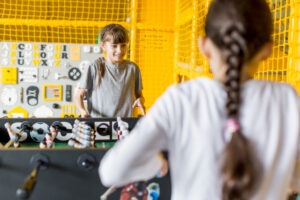
At Kids Arena in Nueva Andalucía, Marbella, children aged 5 to 12 swap the tablet for climbing walls, a ninja course, a zip line and interactive games they play with their whole body. It’s a great way to recharge after homework or online lessons, and the perfect plan for school holidays.
During holidays, our kids’ camps in Marbella combine active games, creativity and new friends for ages 5 to 12. Younger brothers and sisters aged 1 to 4 can play in the Soft Zone.
Frequently Asked Questions
What is the best free online learning platform for kids?
Khan Academy Kids is the best free app for ages 2 to 8, with no ads or subscriptions. For older children, Khan Academy offers free lessons in maths, science and more, with a complete Spanish version.
What are the best online classes for kids?
For live classes with a real teacher, Outschool offers small group video classes for ages 3 to 18 in almost every subject. For self-paced learning, BrainPOP, Smartick and Reading Eggs are strong paid options.
Which online learning platforms are available in Spanish?
Khan Academy, Smartick, Scratch and CodeAI are fully available in Spanish. Khan Academy Kids includes Spanish books, and BrainPOP has a Spanish version for schools.
Is Khanmigo available in Spain?
When we checked in October 2026, Khanmigo’s plans for parents and students were only available in the United States. The rest of Khan Academy is free and available in Spain.
What is the best way for kids to learn coding online?
Start with ScratchJr for ages 5 to 7, move to Scratch from age 8, and try CodeAI’s free courses for a more structured path. All three are free.
How much time should children spend on learning apps?
There is no single rule for every child. Short, regular sessions usually work better than long ones, and learning apps still count as screen time. The WHO recommends at least 60 minutes of physical activity a day for children aged 5 to 17.
Learn Online, Play for Real in Marbella
The best learning routine combines good online tools with plenty of real movement. Bring your child to Kids Arena Marbella to climb, jump and play after school or during the holidays. Weekends and school holidays are busiest, so we recommend booking ahead.
Book your visit · See all activities
Explore more educational resources and fun learning experiences at Kids Arena!
Eurostat Data: View Statistics