The Science of Play: How Active Movement Builds Smarter Brains
Have you ever watched your child struggle to fit a puzzle piece into place or navigate a complex climbing frame, only to see that “aha!” moment when they finally succeed? That’s not just a game; it’s spatial reasoning in action. While we often focus on reading and math, research highlights that spatial skills—the ability to visualize and manipulate objects in space—are a massive predictor of future success in STEM fields.
At Kids Arena, our indoor active fun center in Marbella, we see these skills develop every single day. By moving away from digital screens and into a world of physical movement, children aren’t just burning energy; they are building their brains.
What Exactly are Spatial Skills?
Spatial skills involve understanding how objects move, how they relate to one another, and how we fit into the physical world. It’s the mental muscle we use to:
- Imagine how a shape looks when rotated.
- Estimate the distance between two points.
- Navigate a playground or a new city.
- Assemble furniture or build complex Lego structures.
According to recent insights into child development, these abilities aren’t just “born”; they are practiced. The more a child interacts with their 3D environment, the stronger these skills become.
The Screen-Time Struggle vs. Active Play
In an era of tablets and smartphones, children are spending more time in 2D environments. While some educational apps exist, they cannot replace the multisensory experience of physical play.
When a child climbs a wall or navigates an obstacle course at Kids Arena, they are constantly calculating distances, adjusting their center of gravity, and planning their next move. This “active play” is the gold standard for spatial learning. It keeps kids moving and ensures they spend their energy in a healthy, productive way far from the sedentary pull of a screen.
How Indoor Playgrounds Build Spatial Intelligence
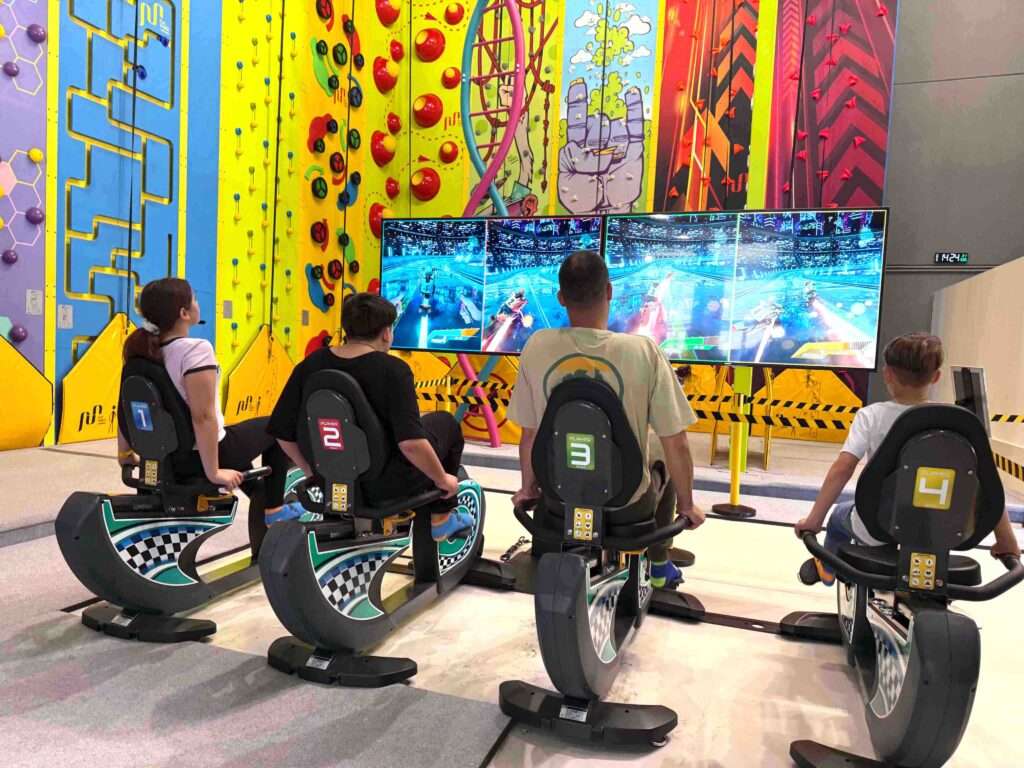
An indoor playground like Kids Arena in Marbella is essentially a giant laboratory for spatial reasoning. Here is how different activities contribute:
1. Navigating 3D Structures
Crawling through tunnels and climbing up ladders requires children to understand where their body is in relation to the structure. This “proprioception” is a key component of spatial intelligence.
2. Strategic Movement
Whether it’s a game of tag or racing through an adventure zone, kids must predict the movement of others. This helps them develop mental rotation skills—the ability to see things from another person’s perspective or angle.
3. Construction and Blocks
Many of our play zones involve building and creating. Manipulating physical blocks helps children understand volume, symmetry, and balance much more effectively than clicking a mouse.
Celebrate and Learn: Birthday Parties at Kids Arena
Why settle for a boring party when you can host an educational adventure? At Kids Arena, we specialize in arranging the most wonderful birthday parties in Marbella.
Our parties combine the joy of celebration with the benefits of active play. While the kids are busy exploring our indoor playground and conquering spatial challenges, they are also building social bonds and confidence. It’s the perfect way to keep them active, healthy, and happy.
Conclusion: Let’s Get Moving!
The evidence is clear: to help our children succeed in a complex world, we need to let them move. Spatial activities are the building blocks of a bright future. By choosing environments that prioritize physical interaction over digital distraction, you are giving your child a head start.
Ready to see those spatial skills in action? Visit www.kidsarena.es to learn more about our indoor play zones, educational adventures, and how we can make your child’s next birthday unforgettable.Source This article is inspired by The Importance Of Spatial Activities For Children’s Development from Forbes. Read the original here: https://www.forbes.com/sites/jonathanwai/2025/09/25/the-importance-of-spatial-activities-for-childrens-development/