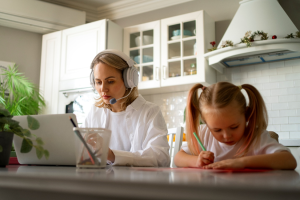
Children today are growing up in a completely different world.
Children today are growing up in a completely different world.
Not just digital.
Not just online.
Artificial intelligence is now part of childhood itself.
From AI-powered toys to chatbots and personalized content, children are interacting with systems that adapt to them, respond to them, and shape how they think.
This is not a small change.
It is a complete rewiring of childhood.
The Promise: A Smarter, Personalized Childhood
AI offers something that was once impossible.
- Personalized learning
- Instant answers to any question
- Adaptive games and experiences
- One-to-one “digital tutors”
In theory, every child can now have access to tools that were once only available to the wealthy.
That sounds like progress.
But it comes with a cost.
The Hidden Risk: A Narrower World
AI doesn’t just teach.
It filters.
When systems constantly adapt to a child’s preferences:
- they show what the child already likes
- they avoid challenge and friction
- they reduce exposure to different ideas
This creates a dangerous loop:
comfort replaces growth
familiarity replaces discovery
Over time, children may become less resilient, less curious, and less open to new experiences.
The Bigger Problem: Replacing Real Life
The real issue is not AI itself.
It’s what it replaces.
When children spend more time with AI systems:
- they move less
- they interact less
- they solve fewer real-world problems
And those are exactly the experiences that build:
- confidence
- social skills
- emotional intelligence
Even recent research warns that heavy reliance on AI tools can reduce real interaction and independent thinking.
When AI Becomes Too Good
AI is designed to be:
- fast
- responsive
- always available
That creates a new risk:
children may prefer AI over real interaction
Some reports show kids using AI for companionship or emotional support—something that was never intended.
That’s not just technology.
That’s a shift in human development.
What Children Still Need (And AI Can’t Replace)
No matter how advanced AI becomes, it cannot replace:
- physical play
- real friendships
- challenges in the real world
- social interaction
These are not optional.
They are the foundation of healthy development.
The Balance Parents Must Create
The solution is not to remove AI.
That’s unrealistic.
The real goal is balance:
- AI for learning is acceptable
- AI for entertainment should be limited
- real-world activity is essential
Parents need to actively design their child’s environment, not just react to it.
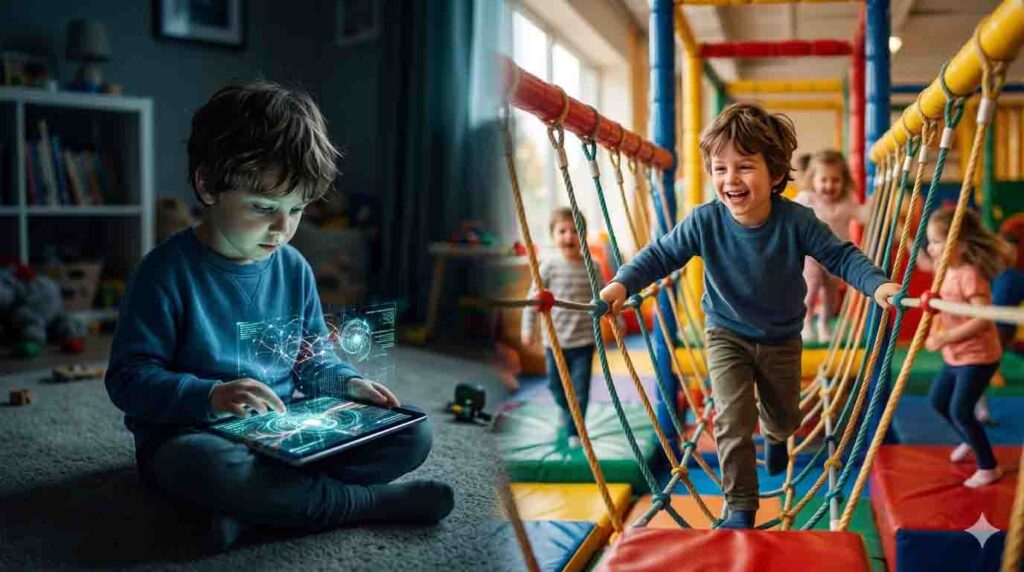
A Real-World Solution in Marbella
If children are spending more time in digital environments, they need strong real-world experiences to balance it.
At Kids Arena Marbella, children step away from screens and into:
- climbing challenges
- interactive games
- physical activities
- social play
They move, interact, and engage naturally.
No algorithms.
No passive consumption.
Just real experiences.
Final Thought
AI is not just changing childhood.
It is redefining it.
The question is not whether children will use AI.
The question is:
Will they grow up with balance, or without it?
Call to Action
Looking for a better balance between digital life and real-world play?
Discover Kids Arena Marbella — where children stay active, social, and fully engaged in the real world.
An indoor playground like Kids Arena in Marbella is essentially a giant laboratory for spatial reasoning.