Children today are not just growing up with technology.
They are growing up with artificial intelligence.
Introduction:
From voice assistants to AI-powered apps, kids interact daily with systems that can answer questions, generate content, and influence how they think.
The real challenge is not access to AI.
It is learning how to use it in a healthy and balanced way.
What Are AI-Native Kids?
AI is already part of everyday childhood:
- voice assistants
- smart recommendations
- educational apps
- content algorithms
But most children use these tools without understanding them.
This creates a gap between usage and awareness, where children rely on technology without questioning it.
The Opportunity: AI Can Support Learning
When used correctly, AI can:
- improve problem-solving skills
- support personalized learning
- encourage curiosity
- help children explore new ideas
AI can be a powerful tool — but only when it is guided.
The Risks Most Parents Underestimate
Without clear boundaries, AI can lead to:
- excessive screen time
- reduced attention span
- passive consumption instead of creativity
- confusion between real and artificial interaction
Children may trust AI too easily and rely on it instead of thinking independently.
Creativity vs. Passive Consumption
AI can either support creativity or replace it.
If children only use AI to get instant answers:
- they stop exploring ideas
- they avoid effort
- they lose the habit of thinking deeply
Creativity requires time, trial, and real-world experience — not just fast results.
The 3 Skills Every AI-Native Child Needs
1. Creativity
Children should use AI to create, not just consume.
Encourage them to:
- build ideas
- ask questions
- experiment
2. Digital Literacy
Children must understand:
- AI is not always correct
- AI does not “think” like humans
- AI is based on data, not truth
3. Healthy Boundaries
This is the most important factor.
Without limits:
- screen time increases
- focus decreases
- real interaction disappears
What Most Parents Get Wrong
The problem is not AI itself.
The real problem is lack of balance.
Removing technology is unrealistic.
Ignoring it is risky.
Guiding it is essential.
The Missing Piece: Real-World Play
No AI tool can replace:
- physical movement
- social interaction
- real-life challenges
These are the experiences that build:
- confidence
- coordination
- communication skills
A Real Solution in Marbella
If children spend most of their time on screens, balance is lost.
They need environments where they can:
- move freely
- interact with other kids
- engage in real activities
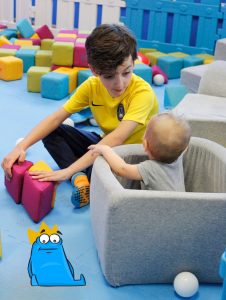
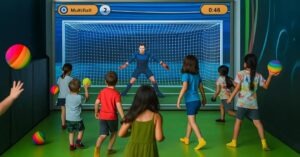
At Kids Arena Marbella, children naturally move away from screens and into:
- climbing
- interactive play
- physical challenges
This is where real development happens.
Final Thought
AI is not the problem.
An unbalanced childhood is.
The goal is simple:
Use technology wisely — and make sure real-world experiences come first.
Looking for a better balance between screen time and real play?
Discover Kids Arena Marbella — where children stay active, engaged, and connected in the real world.